



By Shreya Vaghani 18 Jun 2026
The Death of Corporate Social Media: What Today's Audience Actually Wants
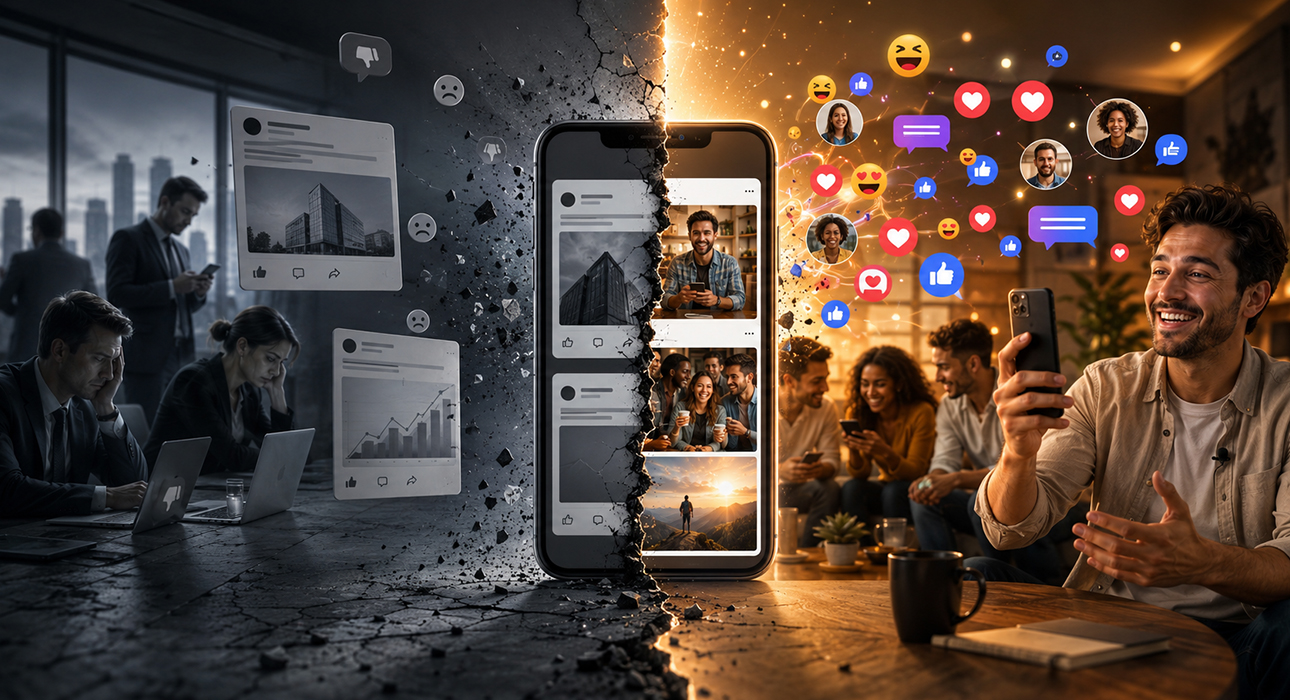
"Most brands aren't losing reach because of the algorithm. They're losing it because audiences have stopped caring."
Introduction:
Scroll through any brand's Instagram or LinkedIn and you'll see the same thing: polished graphics, product announcements, motivational quotes. Everything looks professional. Nothing feels real.
Corporate social media built on scheduled posts, brand guidelines, and committee-approved captions is losing audiences. Not because platforms changed, but because people did. Brand authenticity is no longer a nice-to-have. It's a survival requirement.
The Rise and Fall of Corporate Social Media
In the early days, showing up on social media was enough. Organic reach was enormous, polish signalled credibility, and brands were rewarded simply for being present. Then three things happened simultaneously: platforms became saturated, algorithms crushed organic reach, and a generation raised on YouTube creators and TikTok personalities developed a completely different expectation of what brand content should feel like.
Facebook organic reach dropped from over 16% in 2012 to under 2% by 2022. The corporate content machine kept running. But fewer and fewer people were watching.
Why Today's Audience Scrolls Past Corporate Content
The average person encounters between 4,000 and 10,000 brand messages every day. The brain, wired for survival, filters aggressively and corporate content gets filtered first because it's the most predictable.
The 2024 Edelman Trust Barometer found only 52% of people globally trust businesses. Audiences know there's a PR team, a legal review, and a financial motive behind every post. The moment content feels managed, trust evaporates.
Add ad fatigue 57% of people ignore online ads more than two years ago (HubSpot, 2023) and generic phrases like "We're passionate about innovation" that appear on thousands of pages daily, and you have the full picture. Corporate content doesn't fail because it looks bad. It fails because it feels empty.
What Today's Audience Actually Wants
Audiences don't want perfection. They want honesty. Here's what consistently drives engagement in 2025 and 2026:
• Authenticity: Real opinions, visible humans, content that doesn't feel committee-approved
• Transparency: Brands honest about who they are, what they stand for, and occasionally what went wrong
• Behind-the-scenes content: How things are made, what a day actually looks like, the unfiltered version of building something
• Founder-led content: A founder sharing their journey builds pre-qualified audiences no paid campaign can replicate
• Employee advocacy: Your team's combined networks almost certainly dwarf your brand page following
• Education over promotion: Teach first, sell second; audiences trust brands that help them before asking for anything
When Buffer publicly shared their entire salary spreadsheet and revenue figures, it generated more earned media than any polished campaign they'd ever run. Transparency, not polish, drove the result.
Why Personal Brands Outperform Corporate Pages
People don't connect with logos. They connect with people. The brands generating the most organic engagement right now are almost always ones where a real human – founder, team member, CEO, is the face of the content. Neuroscience backs this: faces and personal stories trigger emotional connection. Logos trigger rational evaluation.
The creator economy, now valued at over $250 billion globally (Goldman Sachs) has permanently shifted expectations. Audiences who spend hours with creators that feel like friends have zero patience for brands that feel like institutions.
The conclusion isn't to abandon your brand page. It's to invest as heavily in the humans within the brand as the brand itself.
The New Rules of Social Media in 2026
• Community-first: The most valuable asset isn't followers, it's a community that talks to each other about your brand
• Employee-generated content: Team members sharing authentic perspectives consistently outperform branded posts on reach and trust
• User-generated content: A genuine customer experience is worth more than any produced video ad
• Conversation over broadcast: The comment section is a marketing opportunity most brands leave completely untouched
• Searchable content: TikTok, Instagram, and LinkedIn now function as search engines; educational content gets discovered months after posting
Common Mistakes Brands Still Make
• Over-polished content that signals inauthenticity before it's even read
• Selling too often — constant product pushes train audiences to scroll past
• Ignoring comments — posting and ghosting destroys community before it starts
• Corporate jargon — "leveraging synergies" actively repels social media audiences
• Chasing trends without strategy — jumping on every meme without brand connection creates confusion, not connection
How Businesses Can Adapt
Start by auditing your last 30 posts honestly: how many feel genuinely human? How many would you personally stop to read? That gap is your strategy brief.
• Introduce one founder or team member post per week and measure the engagement difference
• Respond to every comment, the conversation is the content
• Build a community space on one platform where your audience connects with each other, not just with you
• Create simple guidelines that empower employees to share authentically without requiring approval on every post
• Measure engagement quality, save rate, and DM volume, not just follower count
Conclusion
Corporate social media isn't dying because audiences are fickle. It's dying because it was never really built for audiences, it was built for brands.
"The brands winning tomorrow won't necessarily have bigger budgets. They'll have stronger relationships."
Fewer committee-approved posts, more founder stories. Fewer polished videos, more real conversations. Fewer impressions, more trust. The brands making this transition now, while competitors debate their content calendar will build social media presences that no budget can easily replicate.
How Arowa Webtech Helps Brands Build Social Media That People Actually Want to Follow
At Arowa Webtech, we don't believe in posting for the sake of posting. We help brands build social media strategies grounded in authenticity, community, and genuine audience value.
Our approach covers:
• Social media audits that identify what's working, what's performative, and what needs to change
• Content strategy built around human voices, community growth, and trust-building, not vanity metrics
• Founder and employee content programmes that turn your team's expertise into your most powerful marketing asset
• Community-building frameworks that create owned audiences independent of algorithm changes
• Creator partnership strategies that align brand values with authentic voices
• Performance measurement focused on engagement quality, community growth, and business impact
If you're ready to build a social media presence that people actually care about, not just follow – let's talk. Contact Arowa Webtech for a free Social Media Authenticity Audit.
FAQ
Frequently asked question
Not disappearing but declining sharply in effectiveness. Organic reach has fallen across every major platform, and audience trust in corporate content is at historic lows. Brands adapting to human-centered models are finding new success; those maintaining traditional corporate posting are seeing diminishing returns.
Content saturation, ad fatigue, and emotional disconnection. When every brand looks and sounds the same, content becomes invisible. Audiences are also increasingly skeptical of anything that feels managed or promotional.
Authenticity, transparency, and genuine value. Real human voices over managed personas, behind-the-scenes content over polished productions, and education over promotion.
Critical. Over 80% of consumers say authenticity influences which brands they support (Stackla, 2021). In a feed increasingly filled with AI-generated content, genuine human voices stand out dramatically.
Because people trust people more than logos. Founder content triggers emotional connection, tends to be more opinionated, and is consistently rewarded with greater organic reach by social media algorithms.
A strategy that prioritises building an engaged community over broadcasting to passive followers. It focuses on spaces where the audience talks to each other, not just to the brand creating compounding advocacy and organic reach.
Introduce real human voices, respond to every comment, ask genuine questions, feature user-generated content, and build community spaces. Engagement improves when brands shift from broadcasting to genuine conversation.
Employee-generated content, social media as search engine, AI content saturation making authentic content more valuable, community-first strategies, creator-brand collaborations, and short-form video dominating discovery.
Through consistent transparency, human communication, social proof, responsive community engagement, and educational content that helps without immediately asking for something in return.
Human, community-driven, and authenticity-first. As AI floods platforms with generated content, genuine human voices and real brand personalities become the scarcest and most valuable assets in any social media strategy.
