



By Shreya Vaghani 21 Jul 2026
The In-House Trap: Cheaper on Paper, Costly in Reality: What Happens When You Replace an Agency With One Designer
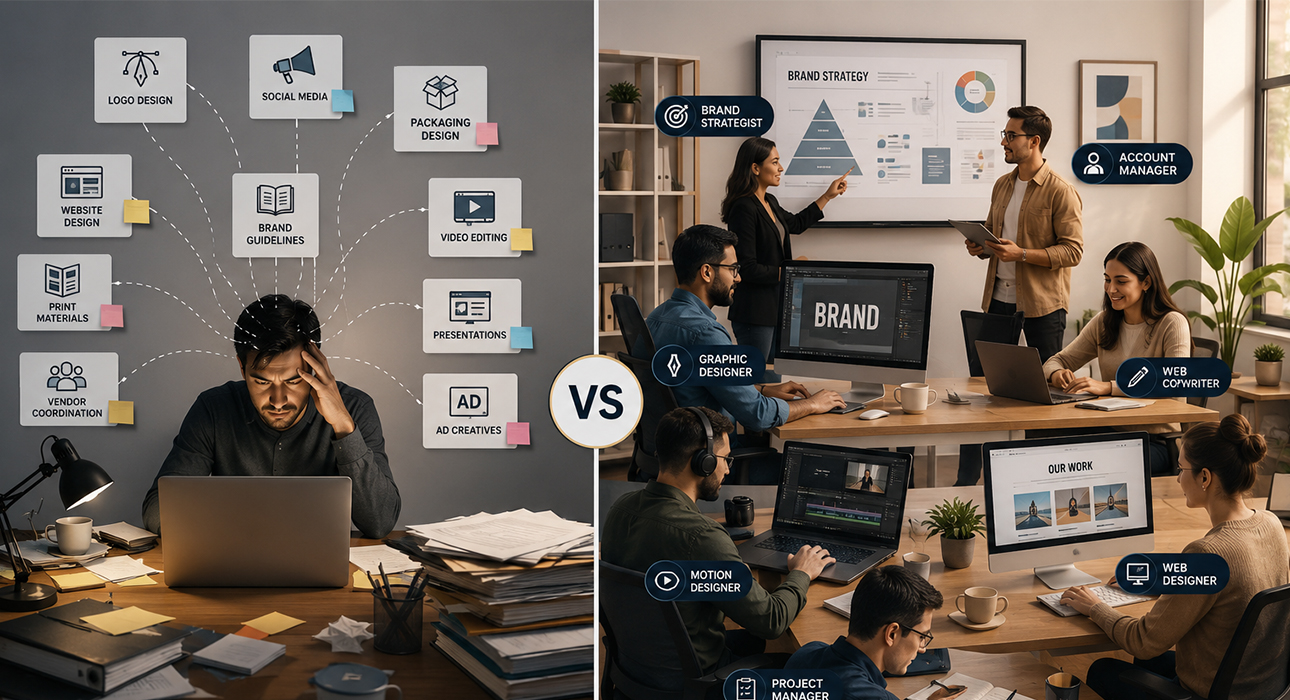
"You cut the agency. You hired a designer. The budget looked healthier. Then, quietly, so did your growth in the wrong direction."
It's one of the most common decisions growing businesses make and one of the most misunderstood. The agency retainer feels expensive. A full-time designer feels like ownership. The maths seems obvious: pay one salary instead of a monthly fee, get dedicated resources and keep the work in-house.
Except the math only works if a designer and a marketing agency are the same thing. They are not even close.
What gets cut isn't the cost. What gets cut is the strategy, the copywriting, the campaigns, the analytics, the SEO, the fresh eyes, and the collective expertise of a team that's been solving marketing problems across dozens of businesses simultaneously. What's left is someone who can make things look good; which is valuable, but it isn't marketing.
This is the in-house trap. And by the time most businesses notice it, six to twelve months of growth momentum have already been quietly lost.
What You Think You're Cutting vs What You're Actually Cutting
When businesses decide to replace an agency with an in-house hire, the decision is almost always framed around cost. The agency retainer is visible, recurring, and easy to point at in a budget review. The value it delivers is distributed, harder to measure, and easy to underestimate until it's gone.
Here's what most businesses think they're cutting when they end the agency relationship:
- A monthly fee that feels disproportionate to what they can see
- Dependency on an external team
- The lag time between brief and delivery
Here's what they're actually cutting:
- A strategist who understands how your marketing fits together
- A copywriter who knows how to make people take action
- An SEO specialist keeping your organic visibility moving
- A media buyer managing your paid spend efficiently
- A team that brings cross-industry perspective your internal hire simply cannot have
- The capacity to scale output without scaling headcount
A designer replaces none of these. A designer makes the outputs of these functions look good. That's a different job.
One Designer vs One Agency: What You Actually Get
This isn't a criticism of designers. Designers are essential. But a designer is a specialist and marketing is a system that requires multiple specialisms working together. Replacing the system with one specialist doesn't simplify the system. It breaks it.
Why Growth Goes Quiet and Why You Don't Notice Immediately
The insidious thing about the in-house trap is the delay. When you make the switch, nothing collapses immediately. The social posts keep going out. The website still looks fine. The brand assets keep getting produced.
But underneath the surface, several things start quietly deteriorating:
Strategy drifts without an anchor
Agencies bring an outside perspective and a strategic framework that keeps marketing activity connected to business goals. Without it, in-house teams, however talented, gradually drift toward executing tasks rather than driving outcomes. Activity replaces strategy. Output replaces impact.
Content volume drops without a system
An agency operates as a production system; multiple people, defined processes, built-in capacity. One designer, regardless of how talented, hits capacity quickly. Blog posts get delayed. Campaign assets take longer. The content calendar empties. And content gaps compound in SEO, in social, in email slowly enough that no single week feels like a crisis, but fast enough that six months later the pipeline looks thin.
Performance data stops driving decisions
Most designers are not analysts. The tracking, the reporting, the conversion monitoring, the A/B testing, it either doesn't happen or happens inconsistently. Decisions that should be data-driven start being made on instinct and internal preference. The feedback loop that improves marketing over time quietly breaks.
The brand starts talking to itself
One of the most underrated things an external agency provides is honest perspective. They see your brand the way your market does, not the way you do. In-house teams, over time, lose this. The brand starts optimising for internal approval rather than external impact. The content starts making sense to people inside the business and losing the people outside it.
The Real Cost Calculation Nobody Does
Businesses that replace agencies with in-house designers almost always compare the wrong numbers. They compare the agency retainer against the designer's salary. The real comparison is different:
- Agency retainer vs salary + employer costs + software subscriptions + freelancer costs for everything the designer can't do + the management time now spent on marketing direction + the opportunity cost of slower campaigns and missed growth windows
When businesses run this full calculation honestly, usually after the fact, the savings are considerably smaller than the budget spreadsheet suggested. Often they're not savings at all.
And none of this accounts for the hardest cost to quantify: the growth that didn't happen during the transition period. The leads that weren't generated. The campaigns that weren't run. The market position that wasn't built while the business was busy saving money on its marketing.
When In-House Actually Makes Sense
This isn't an argument against in-house hiring. It's an argument against replacing a marketing system with a single execution role and calling it equivalent.
In-house makes genuine sense when:
- You have enough volume to justify a full marketing team not one person, but a strategist, a writer, a designer, and an analyst at minimum
- You're at a stage where brand consistency and speed of execution matter more than strategic range
- You pair the in-house hire with an agency for strategy, campaigns, and specialist work the internal team can't cover
The businesses that do this well don't replace their agency with a designer. They build an internal team alongside agency support, each doing what they do best.
The Budget Was Saved. The Growth Wasn't.
"A designer can make your marketing look like it's working. An agency makes it actually work. The gap between those two things shows up in your revenue, usually about six months after you made the switch."
The in-house trap isn't about bad hiring decisions. It's about a misunderstanding of what marketing actually is and what it takes to do it properly.
Design is one part of marketing. An important part. But marketing is strategy, copy, data, campaigns, SEO, media, creative, and the constant external perspective that keeps all of it honest. No single hire replaces that. And the businesses that try to replace it with one usually spend the next year quietly rebuilding what they dismantled.
The retainer felt expensive. The silence that followed was more expensive. It just didn't come with an invoice.
About Arowa Webtech
Arowa Webtech is a digital agency that works with businesses who want marketing that actually moves the needle, not just assets that look good sitting still.
We believe the agency relationship works best when it's built around outcomes, not outputs. If you're questioning what you're getting from your current setup, whether that's an agency, an in-house team, or somewhere in between, we're happy to have that conversation honestly.
Get in touch with Arowa Webtech. No pitch deck. No pressure. Just a straight conversation about what your marketing actually needs.
FAQ
Frequently asked question
On a direct cost comparison, a single in-house designer typically costs less than a full agency retainer. But the real cost comparison must include employer costs, software, freelancer gaps, management time, and the opportunity cost of reduced marketing capability. When businesses run the full calculation, the savings are usually smaller and sometimes nonexistent, compared to what they expected.
A marketing agency provides strategy, copywriting, SEO, paid media management, analytics, campaign planning, and cross-industry perspective, in addition to creative design. An in-house designer typically covers visual execution only. The gap between these two represents the majority of what drives marketing performance and business growth.
Because strategy, content systems, performance tracking, and external perspective are lost in the transition, often without the business immediately noticing. The outputs (social posts, design assets) continue while the underlying marketing engine quietly stops working. The slowdown typically becomes visible six to twelve months after the switch.
In-house hiring makes sense when you're building a full marketing team, not replacing an agency with a single role or when volume and consistency requirements outweigh the need for strategic range. The strongest setups pair an in-house team with agency support for specialist functions and external strategic perspective.
The in-house trap is the common business mistake of replacing a multi-disciplinary marketing agency with a single in-house hire, usually a designer under the assumption that the roles are equivalent. The result is reduced marketing capability, slower growth, and eventual recognition that the apparent cost saving came at a higher strategic cost.
For most growing businesses, the answer is both, used strategically. An agency provides strategic range, specialist expertise, and scalable capacity. An in-house team provides brand intimacy, execution speed, and consistency. Framing this as either or is usually where the mistake begins.
