



By Shreya Vaghani 29 Jan 2026
The 10-Minute Revolution: How Quick Commerce is Rewriting India's Digital Marketing Playbook
Introduction
It's 11 PM. You're craving chocolate ice cream.
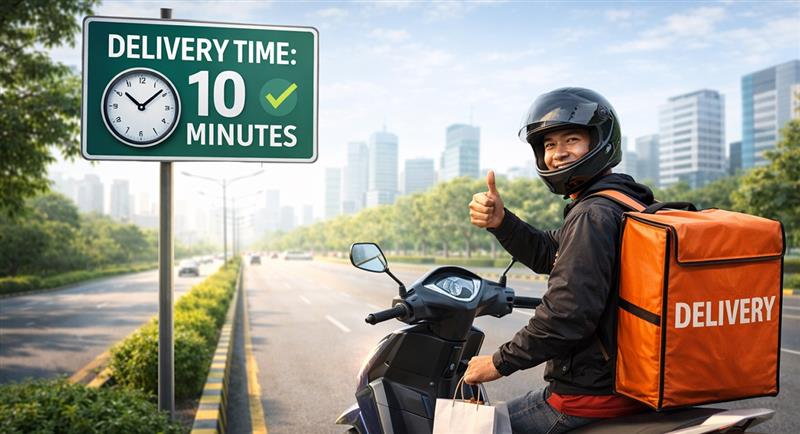
Five years ago, you'd have sighed and waited until tomorrow. Three years ago, you might've ordered for next-day delivery. Today? You open an app, tap twice and it's at your door in 9 minutes. This isn't convenient. This is a complete rewiring of consumer expectations.
India's quick commerce market isn't just growing, it's exploding. Many Online Order Apps have turned "instant gratification" from a psychological concept into a business model.
And here's the part most brands are missing: this shift isn't about logistics. It's about psychology.
When delivery takes 10 minutes instead of 24 hours, everything changes. The customer journey compresses. Purchase decisions accelerate. Brand loyalty becomes more fluid.
And digital marketing? It needs to move at the same breakneck speed. If your marketing strategy still assumes customers will wait, plan or even think twice; you're already losing.
What Quick Commerce Really Means (It's Not Just Speed)
Quick commerce or q-commerce, promises delivery in 10-15 minutes using neighborhood dark stores and hyperlocal fulfillment networks. Companies have essentially turned every few kilometers into its own micro-economy.
But here's what keeps me up at night as a marketer: quick commerce has fundamentally changed the purchase equation.
Traditional e-commerce: Need → Research → Compare → Buy → Wait → Receive
Quick commerce: Want → Buy → Receive
See what disappeared? Research. Comparison. Waiting. The entire consideration phase has been compressed into a single impulse moment. Your digital marketing must capture that exact moment or someone else will.
The New Rules of Digital Marketing in a 10-Minute World
1. Hyperlocal or Invisible
Broadcasting to an entire city? That's yesterday's playbook. Quick commerce demands neighborhood-level precision. Your digital ads need to reflect that granularity.
What works:
Geo-fenced Instagram and Facebook ads targeted to specific pin codes
Google Local Services campaigns highlighting nearby inventory
Neighborhood-specific landing pages that feel personal, not generic
Real-time location-based push notifications
Think about it: when someone in Thaltej searches for "midnight snacks," your ad should show what's actually in stock at your Thaltej dark store-not your Nikol warehouse. That specificity is what converts browsers into buyers.
2. Inventory Transparency is Your New Superpower
In the quick commerce era, "out of stock" isn't just disappointing, it's brand-damaging. Customers expect real-time visibility.
Smart brands are turning operational data into marketing gold. Show live inventory in your ads. Display "available near you" badges. Create urgency with "only 3 left in your area" messaging.
This builds trust faster than any testimonial ever could. Why? Because you're proving reliability before the transaction even happens.
3. Mobile-First Isn't a Strategy, It's Survival
Quick commerce lives on smartphones. Your marketing needs to be born there, not adapted there.
App-exclusive flash sales that reward loyal users
One-tap checkout experiences
Push notifications timed to local shopping patterns
Vertical video ads designed for thumbs, not cursors
If your mobile experience feels like a shrunk-down website, you've already lost the battle. Quick commerce customers won't forgive clunky interfaces or slow-loading pages. They'll just switch apps.
The Psychology Shift You Can't Ignore
Quick commerce isn't changing what people buy, it's changing why and how they buy.
1. Impulse Has Become Strategy
When delivery takes 10 minutes, the mental barrier to "I want" vs. "I need" collapses. That late-night ice cream? Those emergency batteries? That last-minute gift? They're all suddenly feasible.
Your marketing should lean into spontaneity. "Craving something sweet?" works better than "Plan your weekly groceries." Urgency and desire beat careful consideration.
2. Comparison Shopping at Lightspeed
Customers now flip between three apps in 30 seconds, comparing prices in real-time. Your competitive pricing and unique value props must be immediately visible—not buried in product descriptions.
3. Trust Through Reliability
Brands that consistently deliver in 10 minutes earn fierce loyalty. Those that promise and miss? They're deleted faster than you can say "delayed shipment."
Market your track record. "98% delivered within 10 minutes" is a more powerful differentiator than any product feature.
Your Action Plan: Marketing That Moves at Quick Commerce Speed
1. Make Your App the Destination
Websites are for browsing. Apps are for buying. In quick commerce, apps command 3-5x higher engagement and conversion rates.
Funnel your marketing energy into driving app downloads and activations. App-exclusive deals, loyalty programs and personalized recommendations keep customers coming back.
2. Turn Customers into Storytellers
Quick commerce creates "wow" moments. A 9-minute delivery of midnight snacks. Emergency medicine that arrived before the fever got worse. These stories are marketing gold.
Encourage customers to share their experiences on social media. User-generated content featuring your 10-minute delivery builds social proof that no branded ad can match. Run campaigns: "Show us your fastest delivery story."
3. Predict Before They Search
AI and hyperlocal data let you anticipate demand. Friday evening in Indiranagar? Predict party snacks. Monday morning in a corporate area? Coffee and breakfast items.
Build predictive campaigns that serve relevant ads before customers even realize they need something. This isn't creepy—it's helpful when done right.
4. Strategic Urgency Wins
"Limited time offer" has always worked. In quick commerce, it's turbocharged.
Flash sales that last 2 hours. "Order in the next 15 minutes" countdown timers. "Only 5 left in your area" scarcity messaging. These tactics align perfectly with the instant gratification mindset.
But here's the key: urgency must be real. Fake scarcity damages trust. Real scarcity creates action.
5. The Uncomfortable Truth
Quick commerce is exposing which brands truly understand their customers and which have been coasting on convenience monopolies.
When everything is available in 10 minutes, product quality and customer experience become the only differentiators. Your marketing can't hide mediocrity behind shipping times anymore.
This is uncomfortable. It's also an opportunity.
Brands that genuinely deliver value; through better products, smarter recommendations or superior service, will thrive. Those that relied on friction to prevent comparison shopping? They're in trouble.
Where Do You Go From Here?
The quick commerce revolution isn't slowing down. It's accelerating. More dark stores. Faster delivery promises. Tighter competition.
Your digital marketing strategy has two choices: evolve or become irrelevant.
Start here:
Audit your hyperlocal capabilities. Can you target individual neighborhoods? Do you know what's in stock?
Test mobile-first creative. Design ads for thumbs and 5-second attention spans.
Build real-time marketing infrastructure. Can you update ad copy based on inventory? Can you trigger campaigns based on local events?
Measure speed as a KPI. How fast do customers go from ad click to purchase? Where's the friction?
Invest in predictive analytics. What can you anticipate about local demand patterns?
The market is moving at 10-minute speed. Your marketing can't afford to move at 24-hour speed anymore.
Conclusion
Quick commerce isn't a feature. It's a fundamental shift in consumer behavior that's creating winners and losers at unprecedented speed.
The brands winning aren't necessarily the biggest or the oldest. They're the ones that understand this truth: in a world where everything arrives in 10 minutes, your marketing needs to be just as fast, just as relevant and just as hyperlocal as your delivery.
The question isn't whether quick commerce matters to your business. The question is: Are you ready to market at the speed of now?
